

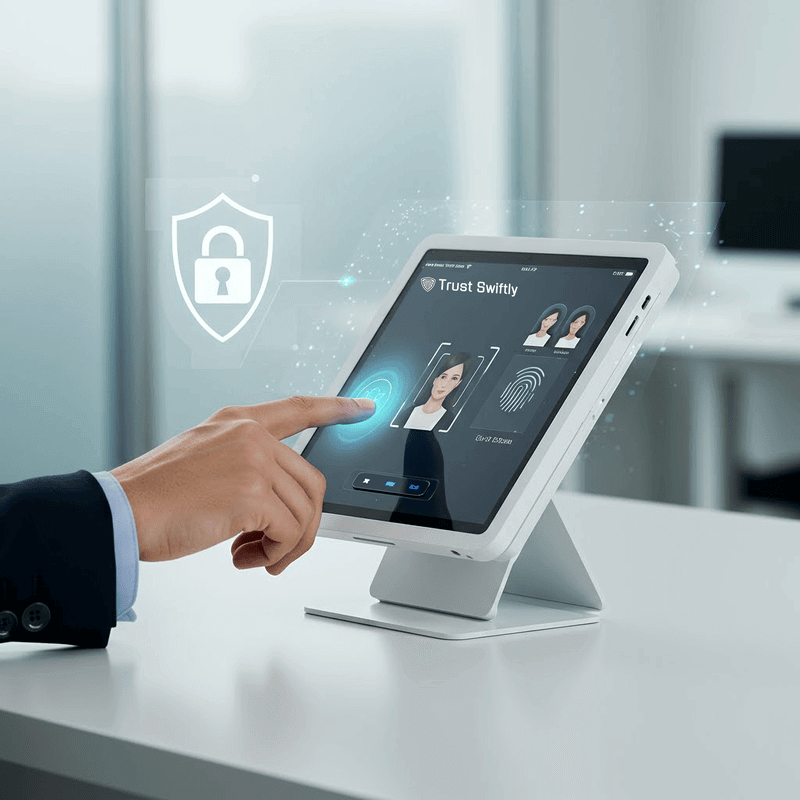
Verification for enrollment at IAL3 involves physically matching enrollee biometrics against identity evidence, using tamper-evident hardware, an interactive remote verification process and adhering to strict definitions of federated assurance levels.
TrustSwiftly's remote IAL3 verification process not only offers both compliance and long-term security but can also help reduce cyber liability insurance premiums by mitigating risk exposure and operational expenses.
NIST IAL3 Verification
NIST IAL3 digital identity verification standards provide the highest level of assurance, requiring either in-person or remote attendance for verification with stringent evidence validation to ensure that claimed digital identities are genuine, thus decreasing impersonation and fraud risks.
Trustswiftly's remote, IAL3-compliant process that combines document authentication, biometric comparison and liveness detection support helps prevent phishing attacks, SIM swapping or MFA bypass.
Contrary to SP 800-63B's non-biometric pathway, IAL3 requires face-to-face interactions between an enrollee and an on-site CSP representative that involves verifying facial images present within identity proofing documents with current biometric enrollment in order to reduce impersonation attacks and stop SIM swapping/MFA bypass attacks by securely linking subscriber biometric credentials with identity proofing information.
NIST IAL3 Compliance
NIST 800-63-4 provides three identity assurance levels (IAL, AAL and FAL), which measure the certainty that claimed identities correspond with real world ones. This framework forms the cornerstone of modern digital identity management practices requiring extensive identity proofing as well as strong phishing-resistant authentication practices such as cryptographic authenticators like FIDO Passkeys and secure PIV/CAC cards for authentication purposes.
SP 800-63-4 outlines minimum requirements to verify an individual's identity over time and in various contexts, adapting to new threats. Furthermore, this standard formally allows remote identity proofing at levels 2 and 3, and loosens hardware specifications at AAL3 so as to increase adoption and support a wider variety of devices.
Trustswiftly performs NIST IAL3 compliance using chat, video, facial recognition with liveness detection and document verification - in combination with support for step-up reproofing based on risk. This holistic and flexible approach enables organizations to meet NIST IAL3 requirements while still fulfilling business and security objectives such as reduced cyber liability insurance costs or operational savings from reduced password resets.
FedRAMP High Identity Proofing
fedramp high identity proofing provides the highest level of identity assurance within the FedRAMP framework and is designed for systems processing sensitive unclassified information with national security implications if compromised. This certification requires rigorous security controls as well as more intensive assessment by an independent 3PAO like Schellman.
Contrary to IAL2 verifications, on-site nist ial3 verification checks involve direct observation of the enrollee as well as cross-verification against multiple photo IDs and at least one biometric characteristic verification for effective protection from impersonation attacks, SIM swapping, MFA bypasses and bypasses of authentication mechanisms such as MFAs. Furthermore, biometric credentials tether securely with identity evidence so as to reduce theft or falsification attempts.
Nist 800-63-4 ial3 compliance not only positions providers to secure federal contracts but also makes them attractive partners to customers in highly regulated industries such as healthcare and financial services, where security-sensitive customers often recognize the value of working with providers who possess FedRAMP High authorization as partners to address their own security needs and meet stringent regulatory requirements. For more information on Nist Ial3 Verification, click here or check out visite site.
Battle-Tested Solutions
State-sponsored actors pose a growing and evolving threat, necessitating an immediate and comprehensive overhaul of federal ial3 identity verification software. Recent hacks, GAO/OIG audits and emergence of regulatory landscape have all highlighted vulnerabilities inherent to unsupervised software-only ID Verification Layer 2 systems (IAL2).
Trust Swiftly's FedRAMP-aligned Supervised Remote Identity Proofing platform combines various adaptable verification methods to protect against sophisticated injection attacks. These include biometric, document, banking, e-passport, signature micro charge and voice verification on controlled hardware to detect suspicious activity and flag it as potential security threats.
Cryptographic NFC document verification methods mathematically verify the secure chips embedded in modern e-passports and mobile driver's licenses, while eliminating presentation attacks by requiring verification to take place on tamper-evident hardware. Their approach is so robust that security researchers have even been invited to try breaking its defenses! As a result, businesses can securely accept risky transactions while protecting legitimate customers while reducing fraud and chargebacks - giving businesses confidence when accepting risky transactions without incurring chargeback fees or fraudsters.